

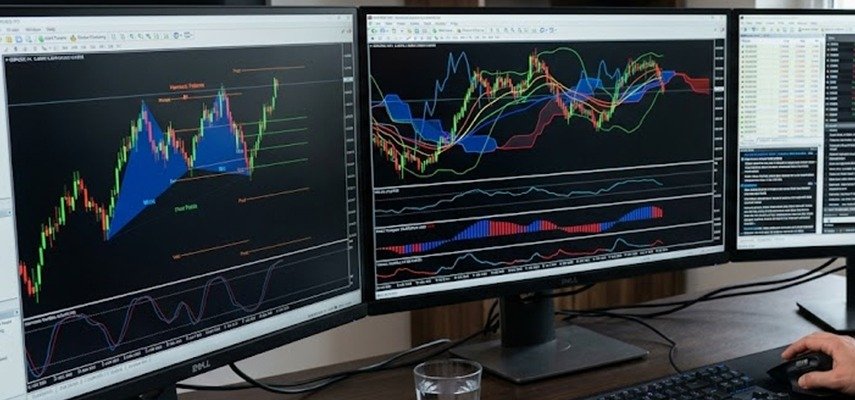
Upon entering my first experience with multi-day market trades, I got hooked just like thousands of other retail traders each year. I flooded my screen with any free chart indicator I could get my hands on. It made my chart look more like a tangled web of colorful lines, and I became obsessed with following each move in the market. As soon as I found a potential entry point, I entered the trade, only to witness the indicator morph its shape or simply disappear altogether a few candles down the line.
I wasted countless hours and capital before accepting the bitter reality: to create a viable and successful strategy, one must switch to professional trading indicators with low latency. If you seek to capitalize on the market movements efficiently without being glued to your computer, you need to switch to a structured approach, which will use reliable algorithms to detect profitable opportunities in the market.
Below I will show you the structural changes which saved my account.
Repainting – The Worst Backtesting Myth Ever
In my early years, I have spent weeks developing trading systems which appeared to be extremely profitable when applied to past price data. The charting platform generated flawless signals for entering the market right at the very bottom of all market downturns. Yet, when it came to the point of using real-time capital in rapidly changing market conditions, the results were shocking. The system signals became distorted, delayed, or simply ceased existing whenever the next price bar contradicted my current position.
What had happened was my experience of falling into the trap of repainting indicators.
And here comes a vital tip that is worth learning from my experience: always develop your stop loss rules based on non-repainting indicators. An institution-level algorithm can be fully developed by applying only closed candles and structural technical indicators. As soon as an indicator value appears on your screen based on a closed bar, this value is irremovable.
[Standard Repainting Tool] —> Retroactively alters past data —> Distorts backtests, causes live losses
[Non-Repainting Algorithm] —> Anchors permanently on close —> Provides objective, verifiable risk metrics
With a predetermined system, you get to believe in your data again, accurately gauge your win rates in the past, and end up getting rid of the emotional stress that normally destroys an execution strategy.
Combining Volatility and Momentum: Trend Following and Swing Trading
I made one of my major strides in improving the execution of my trading plan when I began using different approaches in various market conditions. I started categorizing the system into two separate types, which include the detection of macro momentum and micro pullbacks.
1. Filtering Market Conditions with Trend Following Tools
It would be foolhardy to trade a certain position while not having a clue about the market’s prevailing direction. To that end, I use trend following tools to filter the market and create an undeniable structural filter.
Rather than predicting where the top out is going to occur, these tools allow me to analyze multiple data streams on various timeframes to see the true path of least resistance. Should my main momentum indicator fail to align in both the intermediate and macro time frames, then I simply get out of the way.
2. Timing the Turn Zones with Swing Trading Tools
After knowing where the main market trend is heading, I then apply special swing trading indicators in order to identify the zones for high probability pulls. The market does not operate in a linear fashion; it operates in a cyclic fashion.
Through the use of special tools such as the Avramis swing system, it becomes possible for me to determine where the cyclic peaks and troughs occur using mathematics. This enables me to time a pullback to a support area during a market uptrend.
Redefining Automated Buy/Sell Indicators
A large number of traders have been in search of an automated system with green and red arrows that will enable them to automatically execute financial transactions through the mere appearance of these arrows. Based on my experience, using automated arrows without understanding what goes on behind them is extremely hazardous.
The best possible trading systems do not use entry signals as automatic arrows; rather, these entry signals serve as confirmations.
Whenever my professional algorithms display an alert signal, I know there is a certain set of factors such as current market structure, price volatility, and momentum indicators which have all come together at the exact time. It’s not just a question of buying whenever I see an arrow. It is about buying based on an algorithmic indication that risk-to-reward is highly favorable to me.
Frequently Asked Questions (FAQs)
Why is the use of non-repainting indicators essential for proper backtesting?
The repainting system uses an approach that adjusts its past data visualization so as to render its past entries in an ideal fashion. This means that once you perform your back testing with a repainting indicator, your analysis will only have artificial accuracy. Non-repainting indicators fix the value of the mathematical value once a price bar closes.
What are the differences between swing trading and day trading indicators?
While day trading requires continuous monitoring of the execution through second-by-second tracking of very low timeframes, swing trading indicators have been built to focus on noise-free trades through several days or weeks, meaning that swing trading indicators will help you ride large institutional price swings without having to spend too much time glued to the screen.
Can the novice trader fully depend on the automated buy sell indicators?
No. Trading on auto-pilot without understanding the market structure and not having a well-thought-out risk management plan is one of the easiest methods for account drawdown. Professionals apply indicators of this type not as a secret recipe that will make their lives easy, but rather as an independent mathematical confirmation layer within an overall strategy.
How can a swing trader integrate trend following indicators with his swing trading metrics?
The optimal method would be for the swing trader to incorporate trend following indicators into his strategy by using them as a fundamental layer that helps him decide which direction he is going to trade in (bullish or bearish). Having selected his macro trend direction, he uses swing trading metrics to define exact entry points with limited risk exposure.
Conclusion: Maintaining Your Advantage in the Region
The development that I have undergone from being an emotional and confused retail trader into a well-disciplined systematic operator needed the entire renovation of my technical foundations. The replacement of sluggish and emotionally-charged retail setups and layouts with professional trading indicators for achieving flawless and confident performance was by far the most efficient solution.
For those who strive to achieve this transformation as active traders operating in the Gulf, Tradepedia UAE presents the best professional environment. This highly regarded institute which works directly out of Dubai International Financial Center (DIFC), Dubai, and UAE is licensed by KHDA. Their proprietary indicator packages that do not repaint are available through them and when combined with their high-end algorithmic trading software and expert mentoring, Tradepedia UAE is your best choice in becoming a professional.